How our AI-made video channel got 1.22 lakh views in 7 days
Bible Tales (@BibleTalesTe), made end-to-end with our AI video pipeline: 1.22 lakh views, 3,128 watch hours and +914 subscribers in 7 days (Oct 11–17, 2026). The pipeline, the quality checks and what we learned about YouTube's inauthentic-content policy.
Bible Tales (@BibleTalesTe) is our own YouTube channel of Bible stories. Every video on it is made with the AI video pipeline we build for clients and teach in our weekend workshop. This is what happened in its best week so far, and what we'd do differently.
1.22 lakh
views in 7 days (Oct 11–17, 2026)
3,128
watch hours in the same 7 days
+914
subscribers in the same 7 days
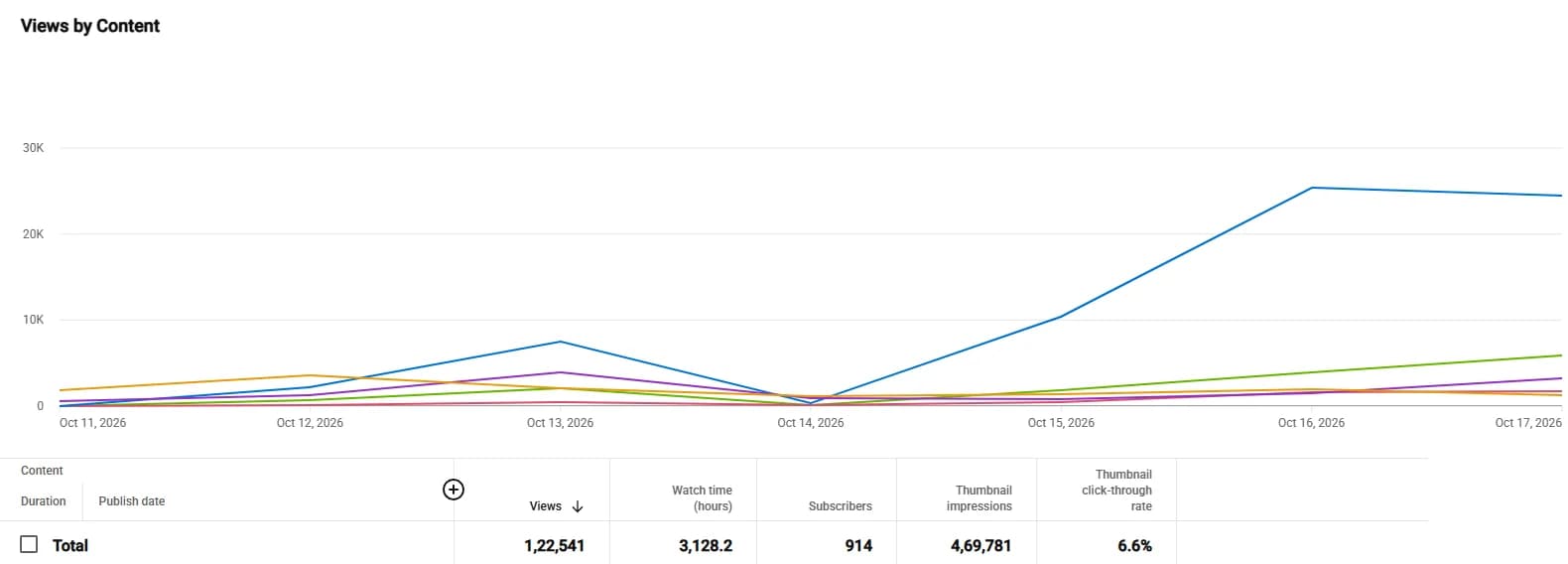
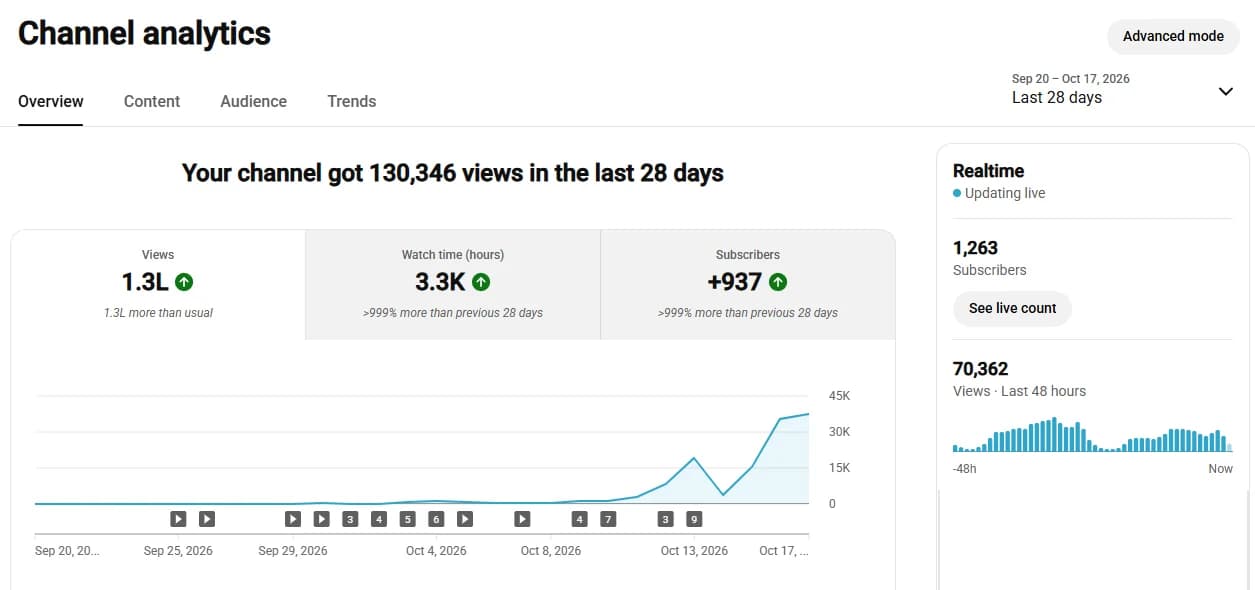
All numbers are from YouTube Studio for the last 7 days, 11 to 17 October 2026: 1,22,541 views, 3,128.2 watch hours, +914 subscribers, 4,69,781 impressions and a 6.6% click-through rate. We're sharing them as proof that the pipeline works, not as a promise: views depend on the topic, the packaging and YouTube itself.
The video that carried the week
Most of the views came from one series: The Book of Enoch. In those 7 days Part 1 got 70,445 views, more than half of the channel's total. Mystery-style topics that viewers can't easily find in their own language did far better than straightforward retellings of familiar stories.
The pipeline
Each film goes through four automated stages:
- Script (local LLM). A language model running on our own GPU turns a topic into a scene-by-scene script in the channel's language, with a beat list.
- Images (FLUX). Each scene gets still frames generated with FLUX, then animated with pan and zoom.
- Voice (IndicF5). The narration is generated with IndicF5, an open text-to-speech model for Indian languages. The same pipeline now voices 30 Indian and global languages.
- Assembly (automated). Frames, voice, music and subtitles are stitched into the final video by script, including the intro and outro.
Running the models locally keeps the cost per video low, which matters when you publish often.
Lesson 1: quality checks decide everything
The hardest part wasn't generating the media. It was catching the bad parts before they reach viewers.
- Images drift. Characters change faces between scenes, and the model adds things that shouldn't be there (watches, glasses, extra feet). Long "don't draw" lists didn't help at the fast settings we used; describing what should be there ("bare wrists") worked better.
- One bad frame shouldn't stop the film. An automatic vision check that passes or fails each frame, and redraws only the failures with a new seed, saves hours of manual review.
- Listen back to the voice. Running speech-to-text on every narration file and comparing it with the script catches mispronounced words and odd pauses.
- Check the story before drawing. Repeated scenes in the script lead straight to repeated images. A beat list with automatic checks for repeats fixes this upstream.
Lesson 2: respect YouTube's inauthentic-content policy
YouTube's monetization review looks at the channel as a whole. Its policy on inauthentic and repetitious content is aimed at mass-produced videos, and AI channels can trip it without meaning to. What we changed, and what we recommend:
- Honest About page that says the visuals are AI-assisted and the scripts are researched by people.
- AI disclosure ("altered or synthetic content") turned on for every upload.
- A steady schedule instead of several uploads within minutes of each other.
- Unique intros and outros per film, written from that film's story instead of one reused template.
- No duplicates or off-topic uploads. We removed a duplicate upload and an off-topic video.
What we'd tell another creator
Pick a series viewers can't easily find elsewhere in their language, invest in automatic quality checks early, and make every video clearly yours. The tools are now good enough; the edge is in the checks and the storytelling.
For every stage, model and setting behind these numbers, read the full stack breakdown. Want this pipeline for your own channel? Join the ₹999 weekend workshop or ask us about an AI Video Studio setup.
Written by Vijay Allam, IndMinds, who builds and runs the AI video pipeline behind our Bible Tales channel and teaches IndMinds programs. Policies and exam details change; we link the official pages so you can check the current version.
Related posts
Newsletter
One useful AI email a week. No spam.
New posts, real numbers from our channel, and the next workshop and batch dates. Unsubscribe with one reply.
Prefer WhatsApp?
Ask a question or get batch dates on WhatsApp. We reply within one working day.