Agentic RAG in production: architecture, retrieval evaluation, guardrails and cost control
A practical engineering guide to agentic RAG in production: reference architecture, chunking and retrieval evaluation, guardrails, cost control and Python code you can adapt.
Retrieval-augmented generation (RAG) is now the default way to make an LLM answer from your data. The prototype takes an afternoon. Getting it to production quality, safely, at a predictable cost, takes engineering discipline. This guide walks through an agentic RAG architecture we'd be comfortable running for a real organisation, with code snippets you can adapt.
Key takeaways
- Start with simple RAG plus an evaluation set; add agentic loops only for failures you've measured.
- Evaluate retrieval and generation separately: recall@k and MRR for retrieval, faithfulness and correctness for answers.
- Hybrid search + re-ranking fixes many retrieval failures before you touch the model.
- Guardrails must live in code (access control, tool limits, output checks), not only in the prompt.
- Track cost per request; cap iterations and tokens; route by difficulty.
Simple RAG vs agentic RAG
Simple RAG is a pipeline: embed the question, fetch the top-k chunks, put them in the prompt, generate. It works well for direct factual questions over a clean document set.
Agentic RAG turns that pipeline into a bounded loop. The model (or a small controller) decides what to do next: answer directly, search, rewrite the query, call a tool, or ask for clarification, and it checks whether the evidence is good enough before answering.
| Simple RAG | Agentic RAG | |
|---|---|---|
| Flow | Fixed: retrieve → generate | Loop: plan → retrieve/tool → grade → answer |
| Good for | Direct lookups, FAQs | Multi-part, multi-source, ambiguous questions |
| Latency and cost | Low, predictable | Higher, variable (needs caps) |
| Testing | Easier | Needs trace-level evaluation |
Reference architecture
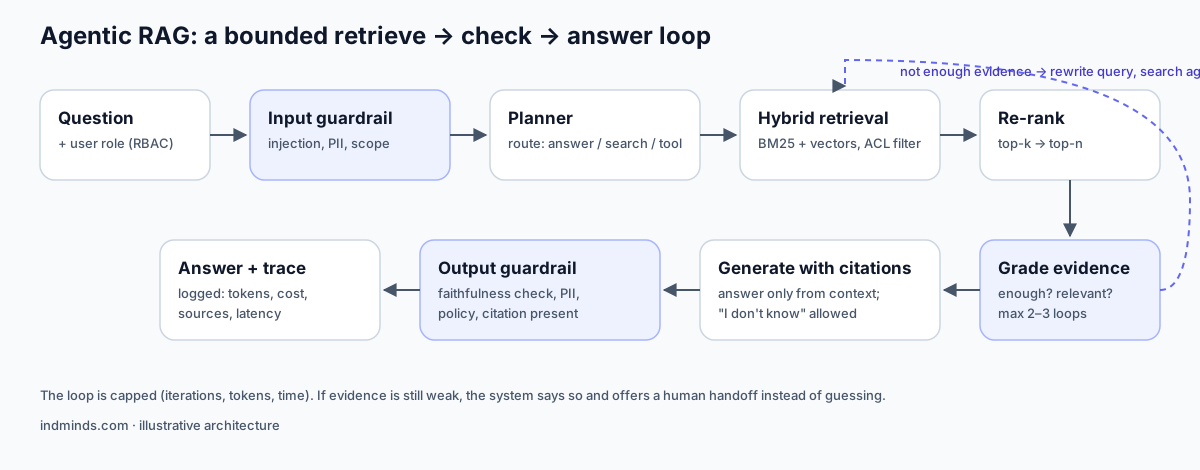
The components:
- Input guardrail: screen for prompt injection, personal data and out-of-scope requests.
- Planner: a small, cheap model call (or rules) that decides the route.
- Hybrid retrieval with access control: keyword (BM25) plus vector search, filtered by the user's permissions in the query itself.
- Re-ranker: reorders the top 20–50 candidates and keeps the best few (example: Vertex AI ranking API).
- Evidence grader: decides whether the context is sufficient; if not, rewrite the query and retry, up to a small cap.
- Generator: answers only from the context, with citations, and is allowed to say "I don't know".
- Output guardrail: checks faithfulness, citations, PII and policy before the answer is shown.
- Tracing: every step is logged with tokens, latency, cost and sources.
Ingestion and chunking
Retrieval quality is decided at ingestion time. Practical rules:
- Parse structure, not just text. Keep headings, table structure and page numbers. A chunk that knows it came from "Leave policy › Section 4.2" retrieves and cites far better.
- Attach metadata to each chunk: source, section path, updated date, and access-control groups.
- Try more than one strategy and let your evaluation decide.
from dataclasses import dataclass, field

@dataclass
class Chunk:
    text: str
    source: str
    section: str
    acl: list[str] = field(default_factory=list)   # groups allowed to read this chunk

def chunk_by_headings(doc_text: str, source: str, acl: list[str], max_chars=1800, overlap=200):
    """Split on markdown-style headings, then window long sections with overlap."""
    chunks, section, buf = [], "Intro", []
    for line in doc_text.splitlines():
        if line.startswith("#"):
            if buf:
                chunks += _window("\n".join(buf), source, section, acl, max_chars, overlap)
            section, buf = line.lstrip("# ").strip(), []
        else:
            buf.append(line)
    if buf:
        chunks += _window("\n".join(buf), source, section, acl, max_chars, overlap)
    return chunks

def _window(text, source, section, acl, max_chars, overlap):
    out, start = [], 0
    while start < len(text):
        piece = text[start:start + max_chars]
        out.append(Chunk(text=f"[{section}]\n{piece}", source=source, section=section, acl=acl))
        start += max_chars - overlap
    return out
Prefixing the section title into the chunk text is a cheap form of context enrichment. Anthropic describes a stronger version, adding a short model-generated context to each chunk, as contextual retrieval; measure whether it helps on your data before paying for it.
Retrieval: hybrid search and re-ranking
Pure vector search misses exact terms (product codes, section numbers, names). Pure keyword search misses paraphrases. Hybrid search combines both. A simple, robust way to merge the two result lists is reciprocal rank fusion (RRF):
def rrf_merge(keyword_hits, vector_hits, k=60, top_n=30):
    """Each *_hits is a list of chunk ids in rank order."""
    scores = {}
    for hits in (keyword_hits, vector_hits):
        for rank, cid in enumerate(hits):
            scores[cid] = scores.get(cid, 0.0) + 1.0 / (k + rank + 1)
    return [cid for cid, _ in sorted(scores.items(), key=lambda x: -x[1])[:top_n]]
Then re-rank the merged candidates and keep the best 4–8 for the prompt. Fewer, better chunks improve answers and cut cost.
Access control belongs in the retrieval query, never only in the prompt:
def retrieve(query, user_groups, search):
    # search() must apply the filter server-side; the model never sees forbidden chunks.
    return search(query, filter={"acl": {"any_of": user_groups}}, top_k=50)
Evaluating retrieval and generation
Build an evaluation set of 50–200 real questions with the passage(s) that answer each and a reference answer. Then measure two layers separately.
Retrieval metrics
def recall_at_k(results: list[list[str]], gold: list[set[str]], k=5):
    hits = sum(1 for r, g in zip(results, gold) if g & set(r[:k]))
    return hits / len(gold)

def mrr(results, gold):
    total = 0.0
    for r, g in zip(results, gold):
        for i, cid in enumerate(r, start=1):
            if cid in g:
                total += 1 / i
                break
    return total / len(gold)
If recall@5 is low, no prompt will save you. Fix parsing, chunking, hybrid weights or the re-ranker first.
Generation metrics
- Faithfulness / groundedness: is every claim supported by the retrieved context?
- Answer relevance: does it answer the question asked?
- Correctness: does it match the reference answer?
- Refusal quality: when the answer isn't in the documents, does it say so?
Libraries such as Ragas and managed services such as Vertex AI's Gen AI evaluation service provide model-graded versions of these metrics. Calibrate any model-graded metric against a sample of human judgements before you trust it.
The agent loop, with hard limits
Here is a framework-agnostic sketch of the bounded loop. llm, search and rerank are your own wrappers.
MAX_STEPS, MAX_TOKENS = 3, 12_000

def answer(question, user):
    trace, context, query = [], [], question
    for step in range(MAX_STEPS):
        hits = rerank(query, retrieve(query, user.groups, search))[:6]
        context += [h for h in hits if h not in context]
        verdict = llm.json(
            "Given the question and passages, reply as JSON: "
            '{"sufficient": bool, "rewrite": str}',
            question=question, passages=[h.text for h in context],
        )
        trace.append({"step": step, "query": query, "hits": [h.id for h in hits], "verdict": verdict})
        if verdict["sufficient"] or tokens_used(trace) > MAX_TOKENS:
            break
        query = verdict["rewrite"] or question
    draft = llm.generate(SYSTEM_ANSWER_ONLY_FROM_CONTEXT, question=question, passages=context)
    checked = output_guardrail(draft, context)
    log_trace(user, question, trace, checked)
    return checked if checked.ok else fallback_message()
Notice what is not here: no unlimited loop, no tool that can write or delete without approval, and no answer that skips the output check.
Guardrails that actually hold
Prompt instructions are helpful but not a security boundary. Put controls in code:
| Risk | Control |
|---|---|
| Prompt injection (direct or hidden in documents) | Treat retrieved text as data; screen inputs and documents; tools are least-privilege; side-effect actions need human approval |
| Data leakage across users | ACL filter in retrieval; never cache answers across permission groups |
| Hallucinated answers | "Answer only from context"; faithfulness check; allow "I don't know" |
| Sensitive data in outputs | PII detection and redaction on output |
| Runaway cost or loops | Step, token and time caps; per-user rate limits |
The OWASP Top 10 for LLM Applications is a good checklist for threat modelling. On Google Cloud, Model Armor can screen prompts and responses, and Gemini has configurable safety filters.
Cost control
- Measure cost per request from day one (input tokens, output tokens, model, number of loop steps).
- Route by difficulty: a small model for the planner and grader; a stronger model only for the final answer when needed.
- Send fewer, better chunks: re-ranking to 4–8 chunks often beats stuffing 30.
- Cache: reuse long, repeated context with context caching where supported, and cache answers to identical questions within the same permission group.
- Cap the loop: most questions should finish in one step; alert if the average climbs.
Production checklist
- Evaluation set versioned; retrieval and answer metrics in CI with a minimum threshold
- ACL filtering enforced server-side and tested with "forbidden document" cases
- Input/output guardrails, plus red-team prompts in the test suite
- Step, token, time and rate limits
- Tracing with sources, latency and cost per request
- Feedback button wired into a review queue that feeds the evaluation set
- Runbook: re-indexing, key rotation, model version changes, rollback
Learn to build it, step by step
Our Applied AI Engineer Bootcamp covers this stack hands-on: Python LLM APIs, production RAG with ChromaDB, LangGraph multi-agent orchestration, evaluation, and FastAPI/Docker deployment on Cloud Run, taught live on Sat & Sun, 10:00–11:30 AM IST.
Sources (official pages, checked Oct 29, 2026)
Frequently asked questions
What is agentic RAG?
Agentic RAG adds a decision loop to retrieval-augmented generation. Instead of one fixed retrieve-then-answer step, the model can decide whether to search, rewrite the query, call a tool, check whether the evidence is sufficient and search again, within limits you set.
When should I use agentic RAG instead of simple RAG?
Start with simple RAG. Move to an agentic loop when your evaluation shows failures that need multiple steps: multi-part questions, questions that need data from different sources, or queries that need rewriting before retrieval works. Agentic loops cost more and are harder to test, so add them for a measured reason.
What chunk size should I use for RAG?
There is no universal best size. It depends on your documents and questions. Try two or three strategies (for example fixed-size with overlap, heading-aware sections and smaller chunks with parent context) and pick the one that scores best on retrieval metrics against your own evaluation set.
How do I evaluate a RAG system?
Evaluate retrieval and generation separately. For retrieval, measure whether the right passages appear in the top results (recall@k, MRR). For generation, measure faithfulness to the retrieved context, answer relevance and correctness against reference answers, using a mix of automated metrics and human review.
How do I stop prompt injection in RAG?
You can't rely on instructions alone. Treat retrieved content as untrusted data, screen inputs and documents, keep tools least-privilege, require approval for actions with side effects, enforce access control in retrieval code, and test with red-team prompts. OWASP's Top 10 for LLM Applications lists the main risks.
How can I reduce the cost of a RAG application?
Route easy queries to smaller models, cap agent iterations and tokens, cache repeated context or answers, re-rank to send fewer but better chunks, and track cost per request so you can see regressions.
Written by Vijay Allam, IndMinds, who builds and runs the AI video pipeline behind our flagship AI YouTube channel and teaches IndMinds programs. Policies and exam details change; we link the official pages so you can check the current version.
Related posts
Newsletter
One useful AI email a week. No spam.
New posts, real numbers from our channel, and the next workshop and batch dates. Unsubscribe with one reply.
Prefer WhatsApp?
Ask a question or get batch dates on WhatsApp. We reply within one working day.