How to start a faceless YouTube channel with AI in India (2026 guide)
A step-by-step guide to starting a faceless YouTube channel with AI in India: choosing a niche, channel ideas that work, the tools for each step, YouTube's monetization and disclosure rules, and a 30-day launch plan.
A faceless YouTube channel is a channel where you never appear on camera: narration over visuals, stories, explainers, documentaries. With AI, one person can now produce videos that used to need a small team. That's why "faceless YouTube channel with AI" is one of the fastest-rising YouTube searches in India.
I run one. Our channel Bible Tales (@BibleTalesTe) is fully faceless and made with our AI video pipeline. In its best week so far (Oct 11–17, 2026) it got 1,22,541 views, 3,128 watch hours and +914 subscribers. Here is what I'd do if I were starting from zero today.
Key takeaways
- Pick a niche you can turn into a series in your viewers' language.
- Faceless is fine for monetization; mass-produced is not.
- Build a repeatable workflow: script, images, voice, assembly, thumbnail.
- Give it 30 days of consistent publishing before judging anything.
Why faceless channels suit India
- Language gaps. Plenty of topics have great videos in one language and almost nothing in others. AI narration in Indian and global languages lets you fill that gap without hiring voice artists.
- Privacy. Many people want to publish alongside a job or studies without becoming a public face.
- Low cost. Open models run on a home PC with a suitable GPU, and cloud tools work on a laptop.
Step 1: choose a niche that can become a series
Good faceless niches have three things: steady curiosity, room in your viewers' language, and enough material for many episodes.
Faceless channel ideas that work well with AI
| Niche | Why it works | Watch out for |
|---|---|---|
| Stories and legends | Strong narrative, natural series | Respect for religious and cultural material |
| History documentaries | Evergreen searches, long watch time | Fact-checking every claim |
| Science and space explainers | Curiosity-driven, visual | Simplify without getting it wrong |
| Kids' moral stories | Large audience | YouTube's "made for kids" rules and quality principles |
| Book and scripture summaries | Series-friendly | Copyright on modern books |
| Mysteries and unsolved cases | High click-through | Don't present fiction as fact |
Avoid niches where an AI persona gives health, legal, financial or political advice. YouTube's monetization policy explicitly excludes AI personas presenting as human experts on sensitive topics (source).
Step 2: set up the channel properly
- Create a Brand Account channel so you can add managers later.
- Write an honest About section: what the channel covers, that visuals are AI-assisted, and that scripts are researched by people. Reviewers look at it.
- Turn on 2-Step Verification on your Google account; it's required for the Partner Program.
- Make a simple banner and logo in your channel's visual style.
Step 3: build a repeatable production workflow
Each video goes through the same eight steps. I walk through each in how to make AI YouTube videos:
- Script: a scene-by-scene script from an LLM, fact-checked and rewritten by you.
- Image prompts: one visual description per scene, with fixed character descriptions.
- Images: FLUX locally, or a cloud image model.
- Voice: one consistent narrator voice; clone only your own voice or one you have permission for.
- Music and subtitles: licensed music, subtitles timed to the audio.
- Assembly: FFmpeg joins everything into the final film.
- Thumbnail and title: clear at phone size, honest about the content.
- Review and upload: you watch it, answer YouTube's AI use question, then publish.
The point of a workflow is that episode 20 is as good as episode 1. Our studio adds quality agents that check every stage before and after generation, because tired humans miss drifting faces and mispronounced names.
Step 4: understand the rules before you upload 50 videos
Three YouTube rules matter most for faceless AI channels. All three are on official YouTube pages:
- Inauthentic content. In July 2025 YouTube renamed its "repetitious content" policy to "inauthentic content" to make clear it covers mass-produced and repetitive videos. AI-generated content "made with generic or unoriginal templates giving the impression of mass production" isn't monetizable (source).
- Reused content. Compilations and clips from elsewhere without meaningful added value aren't monetizable, even with permission.
- AI disclosure. You must disclose realistic AI-generated or meaningfully altered content using the AI use setting in YouTube Studio. YouTube says disclosure alone won't limit a video's audience or its eligibility to earn money (source).
What it means in practice: make every episode clearly different in story and substance, write unique intros and outros, and don't flood the channel with near-identical uploads. I cover this in depth in can AI videos be monetized on YouTube.
Step 5: a 30-day launch plan
| Week | Do this |
|---|---|
| 1 | Pick the niche, research 20 topics, plan your first series of 3–5 episodes, set up the channel and About page |
| 2 | Produce and publish episodes 1–2; make 3 Shorts from each film to lead viewers to the full video |
| 3 | Publish episodes 3–4; check retention graphs in YouTube Studio and fix the weakest part (hook, pacing or voice) |
| 4 | Publish episode 5; double down on the topic with the best click-through and retention; plan the next series |
Keep a simple sheet: topic, title, thumbnail version, click-through rate, average view duration. Patterns show up quickly.
What growth actually looks like
Growth on YouTube is rarely a straight line. Our 28-day chart was flat for weeks and then jumped when one series started being recommended. In that week the top video, The Book of Enoch Part 1, had 70,445 views by itself.
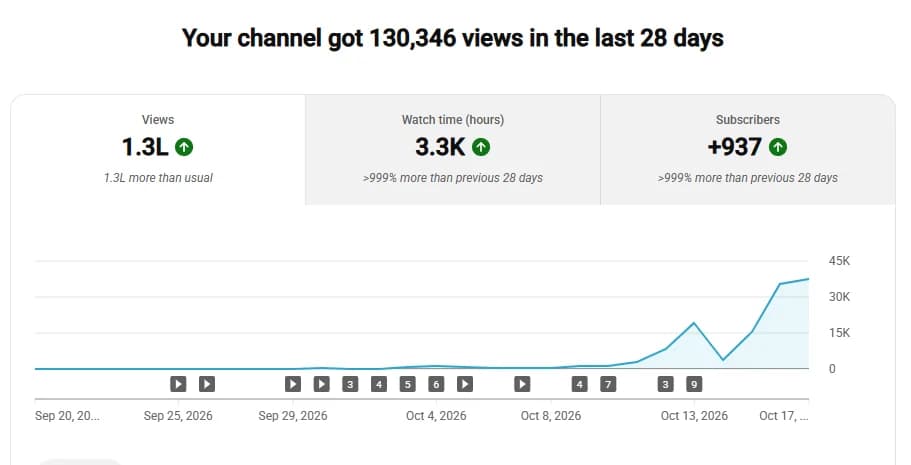
I share this as proof the process can work, not as a promise. Nobody can guarantee views or earnings; that depends on your topics, your packaging and YouTube.
Your starter toolkit
| Need | Free option | Paid or cloud option |
|---|---|---|
| Script | An open model through Ollama | Gemini, OpenAI, Grok, Claude |
| Images | FLUX on your own NVIDIA GPU | Cloud image models |
| Voice | Open voice-cloning models | Gemini TTS, OpenAI TTS |
| Assembly | FFmpeg | Same: FFmpeg is free |
| Music | YouTube Audio Library | A licensed music library |
Common faceless-channel mistakes
- Choosing a niche because a video said it pays well, not because you can make 50 good episodes.
- Using the same template, voice line and music for every intro.
- Publishing 10 videos in a day, then nothing for a month.
- Copying another channel's topics and titles one-for-one.
- Ignoring the comments, which are free topic research.
Where to go from here
Start with one series and one workflow. If you want to see the full stack behind our channel, read How I got 1.22 lakh views in 7 days. If you'd rather build your first video with someone guiding you, that's what the weekend workshop is for.
Sources (official pages, checked Oct 19, 2026)
- YouTube channel monetization policies (inauthentic content, reused content, AI personas)
- Disclosing use of GenAI content
- YouTube Partner Program overview and eligibility
Frequently asked questions
Can a faceless YouTube channel be monetized in India?
Yes. YouTube doesn't require you to show your face. To join the YouTube Partner Program you need to meet the eligibility thresholds and follow the channel monetization policies, which reward original content and exclude mass-produced, repetitive or reused content.
Is it legal to use AI for YouTube videos in India?
Using AI tools to make videos is allowed. You still have to respect copyright, YouTube's Community Guidelines and disclosure rules for realistic synthetic content, and you must not impersonate real people. When in doubt about legal questions, ask a lawyer.
Which faceless niche is best?
The one where people keep searching, few good videos exist in your viewers' language, and you can make a series. Stories, history, mythology retold respectfully, explainers and documentaries suit AI pipelines well. Avoid giving health, legal or financial advice through AI personas; YouTube doesn't monetize that.
How much does it cost to start?
It can be close to zero if you run open models on a computer with a suitable NVIDIA GPU. Without a GPU you can use cloud AI services, which have free tiers or pay-per-use pricing. You don't need paid software to upload or edit.
How long before a faceless channel grows?
There is no reliable timeline. Our own channel had modest weeks before one series took off. Focus on consistent, original episodes and on what your analytics tell you, not on a promised number.
Written by Vijay Allam, IndMinds, who builds and runs the AI video pipeline behind our Bible Tales channel and teaches IndMinds programs. Policies and exam details change; we link the official pages so you can check the current version.
Related posts
Newsletter
One useful AI email a week. No spam.
New posts, real numbers from our channel, and the next workshop and batch dates. Unsubscribe with one reply.
Prefer WhatsApp?
Ask a question or get batch dates on WhatsApp. We reply within one working day.